Links
Cool Cat Teacher Home Page
Best Teacher Blog Winner

Wikis

Subscribe

qrcode
Would love to meet you!

Join the Stop Cyberbullying network.
Elluminate is a sponsor
of Flat Classroom Projects
Get your free Elluminate vRoom
Elluminate is a community partner for the Flat Classroom Project and The Horizon Project
Some Cool Blogs
Neat Bookmarks
Including a classmate with leukemia through skype
Tuesday, February 27, 2007

Hats off to Brian Crosby. Watch this 5 minute movie entitled Inclusion.

How can this sort of power be denied?

I am firmly convinced that because this school allowed a classmate with leukemia to attend via Skype that the lives of both the class and the student are enriched.

This is proof that it is not the tools that are inherently good or evil but rather the use of the tools.

  • A hammer can kill someone but it can also build a house.
  • A nail can be driven through a hand but it can also hold the roof over your head.
  • A fist can hit but a fist can also be clasped in your hand in love.

We do not outlaw hammers, nails, or fists -- we teach people to use them properly.

So should we do with blogs, wikis, podcasts, skype, and any other tool that becomes available for use in the human experience!

(Hat tip to tonights WOW2 show and our incredible guest Wesley Fryer for letting us know about Brian's work. He was on at the very end of the incredible show (along with Miguel Guhlin) where Wes talked about blended learning, digital storytelling, and how people treat "blog" like a four letter word. Catch the podcast on edtechtalk.com as soon as it is posted!) Thanks to my three great friends, Cheryl, Jen, and Sharon for making it all happen every week along with the amazing people at Worldbridges for providing such an incredible, transformational resource for the educational community.

tag: , , , , , ,

Labels: , , ,

Listen to this article Listen to this article
Permalink:
posted by Vicki A. Davis @ Permalink 10:27 PM   9 comments - Leave yours!
Wes Fryer on WOW2 tonight

Come on over to edtechtalk.com if you are online and listen to our live interview with Wes. We start in 4 minutes! If you miss it, come back and listen to the recording. It is going to be great!

Labels:

Listen to this article Listen to this article
Permalink:
posted by Vicki A. Davis @ Permalink 8:56 PM   1 comments - Leave yours!
When did being bored in class deserve disciplinary action?
Sunday, February 25, 2007

After reading the Teacher's at Risk blog post from a few minutes a go, I don't know what makes me angrier at this scenario.

This teacher quotes an article from the Mississauga News:

"A grade six student at St. Sebastian Elementary School has been censored by his principal after writing a speech about being bored in class…”My message is to you,” he (the student) writes in his speech, “let nobody steal your joy by keeping you bored. Find a way out. To be happy is your purpose in life.”


Oh, my goodness.

#1 The student was asked to write a speech. The student wrote a speech.

The student did that and a quite moving one at that! Now, I disagree that one's purpose in life is to just "be happy," however, if the classroom is devoid of happiness and the excitement of learning, something is fundamentally wrong!

#2 Students have a right to their opinion.

If I'm bored, I'm bored. I have a student that stays bored in one of my classes much of the time because he says, "Mrs. Vicki, its not you, but I don't really like computers." He'd rather be doing something else. Now, I really work hard to make it interesting for him.

That is why this 8 week assessment is what I'm calling my Passion Driven Learning project. (It is still in progress, so don't rush to judge the wikis!) The students have selected a "major" and are looking at the computer hardware and software for their "major." This does fascinate him! So, I have given him something to be passionate about in a subject that doesn't bear inherent interest for him.

This being said. If my student is bored and says he's bored, as long as he doesn't "cuss me out" or harm another student... that's his opinion and he has a right to it. (The article says that administration determined that it was disrespectful to a teacher.)

This is not a place we censure students for having opinions unlike ours! This is a place where we encourage opinions and free speech. (Of course, the school is a private Catholic school and I too am at a private school, but this is a little extreme.)

As with all stories, there are certainly two sides to this one and we are only getting one. We also, haven't read the speech. I do believe it is important that teachers are treated with respect and my students do prepend my name with "Mrs." However, on the surface, such thinking as represented in this article is wrong.

Don't think this is isolated

This is the thinking that tells teachers that they cannot blog and express their opinions about work or about personal items because either can be construed as unprofessional. (See the Pennsylvania Teachers Association blogging ethics guidelines.)

What is this place that no longer allows us to disagree with our employer or the place where we go to school?

Yes, I have conservative values but I also believe in the value of democracy. And although I do not take the Lord's name in vain, I believe in the free choice that allows humans to decide whether they wish to or not. (I do however, retain the right to enforce our school's rules on no profanity in my room but if a student wished to write a speech about how I was wrong that would be OK.) That is democracy and I believe that it is a God-given right for humans to be able to determine their own beliefs and express them.

Somehow this fits with a system that doesn't allow students to blog or wiki or podcast. Big Brother is watching and he doesn't want you to say anything that makes him look bad.

Now, do not think that all schools are like this. There are many progressive, amazing schools like mine and others who offer the best education has to offer in meaningful, exciting ways for students. But there seem to be so many more who let fear drive their curriculum. (See my last post about the wiki project that is shut down because of a fear of wikis!)

Faithfulness in a world gone crazy

I read a quote from Mother Teresa tonight. She said,

"I do not pray for success. I pray for faithfulness."


In teaching, I honestly don't think we arrive to a point of "success" I was listening to blogging expert Anne Davis talk about a project she did with fifth graders earlier in the year "That didn't work" and it hit me -- as long as I teach humans and remain human, there will be wins and losses.

I need faithfulness for honestly, as a teacher, I may have successful moments but I don't know that I will ever be 100% successful.

Education is messy and the World is wrinkled

Education is messy -- it is about learning and no one comes into a subject knowing it all, not even the teacher. The world is also not flat, it is wrinkled and high speed internet access is irrelevant if you filter out everything that you try to access.

(I credit Lisa Durff for saying "the world is wrinkled" in our 2/14/07 Wow2 show)

And in this messy classroom with wrinkled internet access, it is important that students be allowed to have a voice.

For truly, one's opinion is their last, sacred frontier and it belongs truly to the one who houses the grey sky of their own mind. We must harness that power of opinion to teach and never seek to carbon copy ourselves. That, my friend, is brainwashing and it has no place in a democracy. I have to wonder if in many places, not just this one school, if we are not seeing the roots of censorship spring.

The Death of a Future

Beware letting wrong take root
though today it be a tiny weed,
Tomorrow it may overshadow all
and kill the future seed.

(Yes, I write poetry too.)

tag: , , , , ,

Labels: , , , ,

Listen to this article Listen to this article
Permalink:
posted by Vicki A. Davis @ Permalink 7:48 PM   9 comments - Leave yours!
Teaching wikis to future educators: My virtual presentation at the College of William and Mary


Tomorrow I am spending time with Sheryl Nussbaum-Beach's class EDUC 330 Tech Enhanced Learning at the College of William and Mary.

I am incredibly impressed with Sheryl's course syllabus and wish that the incredible speakers she has scheduled could present to many colleges at once. She has an incredible line up and I'm going to be listening to her other speakers. I spent today listening to Anne Davis talk about blogging. Wow! I highly suggest that those of you interested in using blogging in the classroom listen to how Anne has been doing it for years with fifth graders. (The recording is in Elluminate.) Anne teaches teachers at Georgia State University and also finds time to spend 2 hours each week in an elementary classroom. She is incredible!

The other speakers? Listen to this:
My Presentation about Wikis Tomorrow
To prepare for my presentation., I uploaded my wikis across the curriculum presentation from the K12online conference to Google Video so that I can embed it in wikis and my blog. If you are interested in wikis, this is still my definitive video on using wikis and what I'm doing. It is still valid post-flat classroom project and can give you how I'm using them. (There are many other teachers who are using wikis in other fascinating ways as well.) That is the video at the beginning of this blog post!

I've also shared my slides for tomorrow with her class. We are presenting over Elluminate and I hope that it will be recorded. If so, I'll share it with you. These slides are on slideshare.


I dug up some fascinating resources at the beginning of the presentation. that you might want to read.

These students of Sheryl's are going to be ready to connect and relate to students in incredible, meaningful ways, that is if administrators and IT folks will get out of their way.

Meanwhile, innovators keep getting doors slammed in their faces!

As I've been writing, I got some disheartening news from one of my favorite pairs of wiki educators. I'm not going to name this person right now, however, this incredible math wiki project for middle schoolers has come to a screeching halt because all wikis are now blocked.

When asked if they could just unblock this one wiki, the answer was "it is either all or nothing."

Firstly, I manage a firewall and there is something in there called "allowed URL's" -- I've seen three or four major firewall interfaces and have never seen one without it. This lets a person allow a specific URL even if the primary URL is blocked. (For example, http://westwood.wikispaces.com could be allowed when all other wikispaces were blocked.) I think this teacher is getting the runaround!

Secondly, I see more and more educators continuing to get excited about new technologies only to have the virtual rug pulled out from under them on global collaborative projects when some person in IT, without direct curricular authority, deciding to "pull the plug."

This is kind of like letting the barnkeeper decide when the horse needs to race based upon when they want to clean out the stable. The horse races when there's a race. The teacher needs to teach when there is a need.

Something is upside down about letting curriculum be driven in this way! There must be communication! What a travesty!

But this is not a single instance. It is happening over and over. Time and again!

Wikis continue to work
Wikis continue to be a great tool in my classroom! They pull together the multiple digital artifacts created by my students in an incredibly easy to use manner!

tag: , , , , , , , , ,

Labels: , ,

Listen to this article Listen to this article
Permalink:
posted by Vicki A. Davis @ Permalink 4:47 PM   8 comments - Leave yours!
Tuesday Night on WOW2: Global Projects and Julie Lindsay
Monday, February 19, 2007

Tomorrow night on the WOW2 show, my friend and global collaboration expert Sharon Peters will be moderating and interviewing Julie Lindsay, from Bangladesh and I about the Flat Classroom Project.

We are quite excited that Thomas Friedman asked for several hundred words about this project to be potentially included in version 3 of his book. This was an honor to be asked by someone we both respect so much. We submitted it to him this week, perhaps it will work out!

After reviewing the new NETS standards proposed by ISTE, Julie and I have concluded that this project meets each standard. Honestly, it was quite striking when we realized this, because the project literally evolved under our fingertips. Each of us pushed the other to do better and include more and we know that there are several areas we will improve upon next time.

I hope you'll join us over at edtechtalk.com, Tuesday night at 9 pm EST. Join in the chat room and listen on Channel 1. It will be a great talk. (Julie and I have literally only talked 3-4 times and have chatted the rest!)

tag: , , , , , , , ,

Labels: , , , , , ,

Listen to this article Listen to this article
Permalink:
posted by Vicki A. Davis @ Permalink 10:55 PM   1 comments - Leave yours!
The Future Wave of School Volunteerism: Be the Textbook
Thursday, February 15, 2007

A simulpost with the TechLearning Blog

The CEO sits down at his desk, slides a few reports into his top desk drawer and straightens pictures on the wall behind his head. Today, he's volunteering at a middle school and he never has to leave his desk.

Businesses bemoan the state of education and rightly so: they need a well-educated, capable, responsible work force able to solve problems and connect with the right people within their company to get things done.

Well, now, virtual tools are getting rid of their excuses for not volunteering. With free Skype, a webcam, and a headset, everyone from the CEO to the intern could potentially volunteer at almost any school around the world with a common language.

Advertisers flock to youtube to encourage average, everyday folks to make what Time Magazine is calling "youmercials."

Well, I've seen the beginnings of "YouTeach" last week as my class interviewed nanotechnology expert, Earl Boysen.

Boysen is the author of the easy-to-understand Nanotechnology for Dummies and the Understanding Nano Website.

I have a first cousin in college who is majoring in nanotechnology and I found nothing in our very up to date textbooks. So, after completing a chapter on computer hardware, my class researched and created a nanotechnology wiki for 70 minutes of class time. Then, using Skype, our class speakers, webcam, and a microphone, my rural Georgia USA classroom dialed up Mr. Boysen in California. (See more about my lesson plan.)

What resulted was an interesting discussion about their future which includes microscopic robotics and particles that could potentially be ingrained in everything from their clothing to their toothpaste. (Listen to the discussion.)

Then, Earl wrote a well researched article in his NanoTechnology now column where he states:

"I hope that other teachers who can make time in their class schedule and master some simple-to-use technologies will consider calling in outside experts via the Internet as one way around current limitations of textbooks and curricula."

It was an "ah-ha" moment of sorts that turned the wheels of my mind in a new direction. When I worked in corporate America, "the company" was always encouraging us to participate in the community, but then, we didn't really have the opportunity because it would usually take 2-3 hours out of our day to head down to a local school to speak. We didn't have the time to really volunteer.

Goodbye excuse, hello kiddies!

What if a visionary company decided to have each of their employees "volunteer" at a variety of schools around the world for 30 minutes once a month?

After the initial set up, it would be just 30 minutes, no more. And that area could be around the corner or in any remote place with Internet access and less than $2500 worth of equipment on site. (A PC, skype, mike, webcam, projector, and speakers.)

Knowledgeable experts in every field can now stop complaining about education and start contributing to education via these inexpensive, easy, connections.

Can we do this now? How can this happen?

Yes, you can volunteer now but I am not aware of any formal programs as of yet.

(There are some that use the expensive virtual conferencing set ups that are being used in many schools. We cannot afford it so we have to use the free VOIP software, Skype. But in many ways, Skype is better because I can stay in my classroom. I am sure there are other VOIP type programs out there that would also work, but Skype is what I use.)

So how will virtual volunteer connections be made?

These virtual volunteer connections are going to be made by the classroom teacher talking about butterflies who has a brother who is an entomologist across the country or the history teacher who has a buddy from college who works at the Smithsonian.

It is going to be some visionary CEO's who set the precedent and encourage their employees to "virtually volunteer" in their area of expertise. It is going to be visionary administrators who allow the installation of free services like Skype in their classrooms and set up methodologies to allow their classes to communicate and share with experts around the world. (We have designated places in each area of our technology curriculum for "state-of-the-art technologies." We should do the same for every subject and allow for "state-of-the-art information exchange" with experts and other classrooms.)

Here is what has to happen in the classroom to make such connections:

1 - Plan ahead, identify upcoming areas in your curriculum that could use augmentation and experts that you already know.

Do not be afraid of areas where you have no expertise, as in the case of my nanotechnology interview, I selected something I knew literally nothing about.

2 - Learn to use Skype

(I have a video on using skype in the classroom) and there are some great articles about it. Set up your webcam, microphone, and use it personally to connect with others.

3 - Locate or connect with experts and teach them to use Skype.

Start by e-mailing them and start with people you know that will be patient with you while you work out the kinks.

4 - Prepare your class.

Make sure they have a basic subject knowledge which can be done easily with Internet research and an exploratory wiki where students post their findings. The expert can then review what students already know and see where they need to fill in the gaps. Don't expect the expert to "hold the class," after all they are not there, and it is your job. You should prepare the students for the information exchange and have them formulate questions in advance. Formulating critical questions requires them to grapple with the subject at hand and have understanding that can truly be built upon by an expert.

5 - Test the class Skype connection with a teacher in another classroom at your school.

Here is how I set up the hardware in my classroom:

There is a big difference between skyping individually and skyping in a classroom because of the potential enemy of any open mike -- Feedback. Feedback is the result of an "infinite loop" when a live microphone is put in front of its own speakers. It is that squeal that we hate. I tested a variety of methods but ended up having the classroom speakers turned up to full volume and had a handheld microphone that I held behind the speakers except for asking questions from the students. When the students asked questions, I set up the speakers so that their voices did not go through the speakers. When they finished, I took the mike back and our speaker answered the question.

I set up the webcam and pointed it at the class, not at me, and had the student asking the questions move up towards the webcam so our speaker could see them. The speaker's video was shown on the board via my projector so that the students could see his facial expressions and mannerisms. It was a very powerful experience.

6 - Do a test call with your expert.

Earl and I did this several days ahead of time. This is VERY important especially if they are just setting up skype. Working with the sound settings can be kind of tricky so you need time for that. (I recommend NOT letting Skype handle your sound settings automatically. You should both do it manually.)

If you're going to record with software like Pretty may, test that when you make the call.

7 - Conduct the Interview

Start promptly. End promptly, they are busy people. If you waste their time, they won't do it again. Remember the time zone differences, you may have to work with administration to have your class at an odd time to make the interview happen. (I had to switch my planning period for the student's Spanish class which was later in the day.)

8 - Follow up After the Interview

Business people like being thanked and an e-mail is great. But, if you have their permission, you should definitely write about the experience and post any media that you had permission ahead of time to record. Sometimes they may want to listen to it or have you edit it, work with them. Again, a bad experience will make them not want to work with you next year.

I even posted the interview on our school news blog so that our parents could listen to it. It is important to share information with the community at large, particularly information that is as cutting edge as nanotechnology -- they need to know about it too and you can become recognized for the cutting edge work that you are doing in the classroom.

Bring on the Army of Virtual Volunteers

We have a way to go before this is possible. Many bandwidth guardians are fighting skype because of the potential bandwidth drain (although if you look at the facts, it is less than many other services.) Some are afraid because teachers can make internet phone calls. (I use it to call parents.) As with any medium, Skype or any VOIP (voice over internet protocol) software can be used for good or for bad and schools must update acceptable use policies and antivirus protection to facilitate its use.

I believe that with the support of good administration and IT departments, responsible educators can use this for great good in their classroom. I believe that responsible businesses can help their employees have a rewarding experience that does not significantly impact their productivity but provides great rewards. (Not to mention the publicity of their company that comes from their employees popping up in virtual "youmercials" via class podcasts/videos around the world.) Just look at my husband wearing his business' name in the Flat Classroom video that won the best best video award. Actually, it wasn't intentional that he wore that shirt, he was on the way to work at 6 a.m. and it was urgent to get the video that morning! And no, I didn't pick the awards!

As educators, let's work together to augment our textbooks with appropriate ways to connect with experts in the subject area we teach. As a former president of my local chamber of commerce, I encourage business people to unite to positively impact the education systems you so desperately want to improve. Virtual volunteers unite!

"These are the best of times. These are the worst of times."

Dickens would again pen these words if he looked at education today.

For those willing to innovate, do the right thing, hire the best teachers and empower them, change their policies and IT support, and lobby for change at the highest levels of government, it is a rich, rewarding, exciting time of change. For those who hate change and want things to stay the same, the worst of times have only begun.

Miguel is encouraging his teachers to, are you?

tag: , , , , , l="tag" >Skype

Labels: , , , , ,

Listen to this article Listen to this article
Permalink:
posted by Vicki A. Davis @ Permalink 10:38 PM   13 comments - Leave yours!
Proof that the best of us can be taken: Microsoft Firefox Professional
Monday, February 12, 2007

Following are the comments with some documentation as to the non-authenticity of this site. Thank you, friends for clarifying. I'm sure I'll get some "she's so stupid" posts but I'll leave this up to show how the best of us can be taken.

I literally researched this for an hour and looked at many blogs and other sources to find the veracity of this. Needless to say, I didn't spend enough time on the site to find what the commenters here are saying.

It bothers me greatly that such spoofs even exist and are allowed to continue. I see now that Google Adsense is on the site. And I would say this -- shame on Google Adsense for paying a site money on a false identity that obviously is out to scam people. The fact that they would pay will make people have more and more clever sites which means this will only get worse.

I will have to determine how to verify such sites in a better way, but how. Is there a site that mentions website spoofs? Couldn't Google offer a filter to get rid of website spoofs just like spam?

******And now for my tirade that is not correct.******

I train my students to look for new technology, so when one of my students said:

"Cool, Mrs. Vicki, there is a new Microsoft Firefox 2007 Professional. Can I download it?"
I was curious and I always check these things out before allowing any student to download something like this.

So, I went to the website: http://www.msfirefox.com/

I was excited..then my excitement turned to OFFENSE as I saw the screen below.

Then, as I tabbed over, I learned two things:

1) It requires a Pentium Quad Core Processor with 4.6 Ghz (our 6 month old computers will not run)

and

2) Under the fast fun tab, this is why Microsoft Says it should be downloaded:

"Tired of slow image rendering? Microsoft Firefox 2007 can deliver online pornography at blazing fiery speeds..."

Well, you can read the rest for yourself in the graphic I snagged from the site above.

Well, I am incredulous, so I looked up the site to see how many blogs have linked to it on Technorati - over 1,700 links!

I found an article at Redherring that says:

"Mozilla has even been working with its archrival Microsoft to make Firefox compatible with the new Windows Vista operating system."
So, no, it doesn't look as if Microsoft has bought Firefox, just trying to literally "get in bed with them." (Pardon the really bad pun)

My protest

As a teacher, I am stunned and appalled by the marketing of this web browser if indeed it is from Microsoft. On the about page of the MS firefox page, it even has a link to the Microsoft educational Foundation.

I know that pornography is a prominent use of the Internet but for Microsoft to campaign for the download of this browser using such offensive language (obviously directed at a female) is offensive to me beyond compare.

It also is at the view of kids everywhere and in my opinion, gives an endorsement of pornography as a valid use of the Internet. The studies I've seen show a correlation between porn use and a decreased satisfaction with a person one is married to. (surprise!?!)

I have used Microsoft Products in my school. I haven't seen Linux or Firefox even tout the effectiveness of their OS or add ons for using porn. It just smacks of bad taste.

Bad play, Microsoft. This teacher would send you to detention if she could!


And if I am wrong, its not intentional -- I have researched for an hour and cannot find anything stating that this is not Microsoft. If Alfred Thompson, educational Microsoft blogger extraordinaire, can dig into it and correct me, I will post a correction immediately! Meanwhile, I am disgusted and will continue to complain!

Added at 5:45 pm on the day of the post.

Meanwhile, I must sit back as countless people will post about my failure here to detect a spoof site. Laugh at me if you will, but if I can't tell -- how many other people won't be able to either. And how do we create students who won't fall for such? I could take this post down, however, I think there is something to learn here.

And I'm not done with this topic! Not by a long shot!


Related Tags: , , , , , , ,

Labels: , , ,

Listen to this article Listen to this article
Permalink:
posted by Vicki A. Davis @ Permalink 4:33 PM   19 comments - Leave yours!
Interview with Nanotechnology expert, Earl Boysen

I was excited last week to connect with Nanotechnology expert, Earl Boysen. Using the miracle of video skype, we saw each other and had a conversation about nanotechnology. We completed a chapter on Computer Hardware and if one looks at the specific definition of a computer, nanotechnology and quantum computing should be at least understood.

I want my students to understand the ethics that arise from being surrounded by devices that are microscopic. If you bought something with nanotechnology in it -- how could you verify it? If you buy a computer now -- you can see it, pick up the box, and take it home. Nanotechnology will be used in the fabrics we buy, and indeed is in the sunscreen that we use today. (I didn't know that.)

Following is the audio file of our class interview with Earl Boysen, author of Nanotechnology for Dummies and www.understandingnano.com - he is also a columnist for Nanotechnology. We had a great conversation where students were allowed to ask questions and be asked questions.

You can listen to the interview over your computer speakers.


powered by ODEO

The Preparation

This is an example of how a class can learn about a concept when the teacher knows very little.

Here is how I taught something to my students when I knew practically nothing!

1) The Wiki Exploratory Project

The students created a wiki to prepare for the interview. The students elected a project manager and determined four critical questions that would give them a basis for understanding nanotechnology:
They explored websites and created their wikis in a class and a half (75 minutes).

2) The Interview

I set up my laptop to hook into our classroom speakers and a separate mike to prevent feedback. We determined the order of the interview to allow time for student questions and for Mr. Boysen to ask our students questions as well.

We spent thirty minutes talking with Mr. Boysen who is in California over Skype computer telephone service. (A free tool that is blocked in most schools because you can also make phone calls!) It was an internet telephone call with full video and audio (and was free!)

3) Post-Interview

Students were to post their "corrections" to the wiki.

I created a podcast to share with parents and students. Then I posted an article on the school blog which links with our school homepage. (This is done automatically using Feedburner -- if you want the steps -- see my blog post about how to easily RSS your website.)

Why tell parents?

As purveyors of new technology, we must consistently remind people about its importance. Many adults and parents mistakenly think that because something sounds confusing that it automatically belongs at the college level, this is wrong! Boysen believes that Nanotechnology should be discussed in high school physics and chemistry classes.

And when I did some research into the inclusion of this topic (and some other engineering topics) I found a study showing how our most popular middle school and high school science textbooks are severely lacking in fundamental issues they should cover. (Look to see if your science book is on the list.)

Here is what I told the parents of our students:

"Technology is changing faster than the textbooks, and we work hard to bring students to the cusp of technology so that they will be prepared for the accelerating pace of college and technological change. Students have to be lifelong learners who can go out and find answers and be unafraid of new things. I am proud of how well they did in the conversation today," says Mrs. Davis.
No, not everyone can connect with this researcher, but using Skype you can connect. This is how to bring people into the classroom and I believe will bring in a new wave of virtual volunteers into our schools. Top CEO's and others can help the most remote, impoverished schools through virtual access using such tools as Skype.

I think Skype is a must have service for teachers in any school. I use it on a daily basis to connect, plan, and answer questions. I am beginning to use it on a weekly basis to teach and connect with other classrooms.


Related Tags: , , , , ,

Tags:

Labels: , ,

Listen to this article Listen to this article
Permalink:
posted by Vicki A. Davis @ Permalink 4:08 PM   1 comments - Leave yours!
Flat Classroom Results aligned with ISTE Standards
Saturday, February 10, 2007


I have a channel on youtube. (http://www.youtube.com/coolcatteacher) If you have a username on youtube, you may navigate to my channel and hit subscribe. That way all of my videos will go straight to you.

I also have a coolcatteacher group and am going to join the K12 group. Groups let multiple people add. The coolcat teacher group is for those of you who have videos that you want me to review or about the things I've worked with.

Julie and I are compiling two final summative videos: one on the objectives accomplished (mine is shown below) and another as a how to.

I have taken the ISTE standards and aligned them with what we accomplished on the flat classroom project. I also discussed how we will change the project in the future (we hope) and what types of classrooms this is best suited for.

Unfortunately I had to upload this to Google Video because it is longer than 10 minutes (14 to be exact.) (See Video)

In the future, I am going to start working to stay under the 10 minute time limit for youtube. But I want you to think a moment -- you can have private groups on youtube. Why don't you have a school news channel and only invite your parents and students to view?

It is free and very very cool. Also, you can get a specific channel URL like I have (http://www.youtube.com/coolcatteacher) and I believe that most filters can unblock a specific URL. That way you could use at least your channel at school even if you can't do anything else there.

You tube is an incredible tool waiting for a use. There are already GREAT videos out there for classrooms. If you don't believe me, look at the 2nd place wiki for the k12 online conference about math videos. They include so many videos aligned with math standards -- I used the one about exponents for my SAT math review!


tag: , , , , , , , , , ,

Labels: , , , , ,

Listen to this article Listen to this article
Permalink:
posted by Vicki A. Davis @ Permalink 3:30 PM   2 comments - Leave yours!
Stephen Downes, connectivism and second life
Thursday, February 08, 2007


I am in overload -- I listened to Stephen Downes today. He used analogies to teach, making me think that networks are modeled in everything from river tributaries to the human mind to the networks built over the Internet. Some connections are explainable and logical, but many are the product of chaos theory at work.

He makes a lot of sense and I think that curriculum directors everywhere should listen to the audio file of his presentation today and look at his Powerpoints.

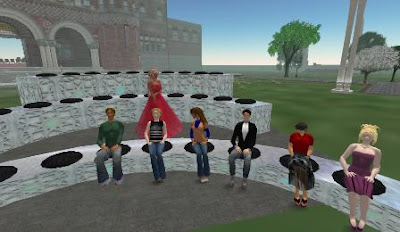
Then, I spent time in Second Life, learning and thinking (and taking pictures (see them to the right.) I made connections with many new teachers who are now my "friends" in second life. I learned so much. (The best tour guide is Beth Ritter-Guth -- she is helpful and outstanding - a perfect person to take a group in. If you have a group going in soon, please mention it to me so I can share it with those who want to try it out!)

I really want us to figure out a way to have teacher / student areas away from the teen and the adult areas. Not sure how that could happen, but it is needed. I have some ideas as do many others.

I can't help but think that I touched the train hanging off the future bride of education. (Or something like her.)

Bottom line is that learning in second life is truly first person learning but when dealing with students it is sans one very important thing -- stereotypes. (There is no such thing as second person learning. )


So perhaps second life isn't a second life at all but a real life. Just a new way of living it.

I am so overwhelmed that as I have perused my youtube and build the channels I subscribe to over there, I came across this video. The beginning of this video is from an American perspective and I tend to not like the fear aspect of it. (We should all reform education because its the right thing to do, not necessarily because we're fearful.)

However, once you get into the video, the points made in this video are throughout the entire connectivism conference. Video is a powerful tool!


tag: , , , , ,

Labels: , , , ,

Listen to this article Listen to this article
Permalink:
posted by Vicki A. Davis @ Permalink 11:32 PM   9 comments - Leave yours!
How I started in wikis, the Flat Classroom and Second Life

I'd like to share a transcript of an interview I did with Stephen Hogg today. For many new readers who wonder how I started in wikis and how beginners get started, it includes a lot of great information.

(Note: Interesting thing about campfire, it shows the time of the host -- So, this was 2 hours later my time -- just a note b/c I have a rule that I don't blog at school.)


Stephen H.
Where do you teach and what grades/classes do you teach?
Vicki D.
I teach at Westwood Schools in Camilla GA
Vicki D.
I teach one semester of keyboarding to 8th grade and 8 weeks to 5th grade.
Vicki D.
I teach Computer Fundamentals to 9th, Computer Science to 10th
Stephen H.
So is your school K-12?
Vicki D.
and electives to juniors and seniors including computer graphic design (1 semester) and accounting (1 semester)
Vicki D.
K3-12th grade -- private school with 350 students.
Stephen H.
Wow, that is a lot of preps you have!
Vicki D.
Before coming here I taught professional development courses for teachers for aobut 10 years -- teachers in all types of schools.
Feb 8
3:15 PM
Vicki D.
Public and private.
Vicki D.
I have no more than 5 classes at a time.
Vicki D.
2 planning periods.
Stephen H.
Oh, ok.
Stephen H.
How did you first begin using wikis in the classroom?
Vicki D.
After going to GAETC(Georgia Association of Educators) in November 2005, I heard DAvid Warlick speak and bought his book about blogs in the classroom.
Vicki D.
Had been going through a lot of professional development training about project based learning, cooperative learning, and genuine assessment
Vicki D.
We focus here on research based best practices and I have to do a certain amount of genuine assessment and cooperative learning.
Vicki D.
I blog, but felt that wikis would work well in a collaborative / cooperative environemtn
Vicki D.
Because of how well that they mark and denote the exact contribution of students.
Vicki D.
It also documents very well the discussions that take place between students to arrive at a certain place of knowledge and their agreement on fact.
Vicki D.
Sometimes the discussion tabs are more helpful than the page itself.
Stephen H.
I hadn't thought about how they show who does what, that's a great point.
Vicki D.
So, I found it as a way to cooperatively compile information and to link all the digital artifacts we were creating in one place.
Vicki D.
It just fit the research well, I thought as did our curriculum director and so we started using them in December 2005.
Stephen H.
Great. What wiki software have you used most often or found to work the best?
Vicki D.
I use wikispaces because I prefer things that I do not host on site.
Vicki D.
Stephen H.
I'm sorry if I interrupt you and you still have more to say. One bad thing about Campfire is I can't tell when you're typing.
Vicki D.
They allow you to have private pages, public pages and also members only editing and even members only viewing -- so I can create a private wiki for younger kids and have a public for older ones but only allow my students to edit.
Vicki D.
Done.
Vicki D.
How about when I'm done, I"ll type a *
Stephen H.
I have been using wikispaces as well.
Stephen H.
That would be awesome
Vicki D.
Very easy to use.
Vicki D.
*
Stephen H.
I have read a little bit about your project the "Flat Classroom Wiki." Could you explain the basics of this project?
Feb 8
3:20 PM
Vicki D.
It is a cooperative project between my 10th grade computer science class and an 11th grade class at the International School in Dhaka Bangladesh with an amazing teacher, Julie Lindsey.
Vicki D.
Julie and I started sharing e-mails about our student views on the World is Flat by Thomas Friedman
Vicki D.
and we wanted our students to have the opportunity not only to learn about the concepts but to experience them as well
Vicki D.
So, they would have academic factual information they would compile but also would experience the flatteners as well as they worked collaboratively with one another.
Vicki D.
We paired up the students with one in her classroom and one in mine although we had a few larger groups due to absences.*
Stephen H.
That is something I would love to do with my students and students from Spain or Mexico or any Spanish-speaking country.
Vicki D.
Yes, it is called tandem learning in foreign language circles and I haven't heard it used in regular academic subjects but expect that it will be.
Vicki D.
The tough thing with different time zones is that they are never in class at the same time -- that is the struggle with an asynchronous project like this.
Vicki D.
Just a moment - I will step away 1 minute while you type.*
Stephen H.
I could see how that would be a problem.
Stephen H.
Ok, no problem
Stephen H.
Ok, besides the "Flat Classroom Wiki," can you give me a specific example or two of other ways you have used wikis in your classes? and in what ways have they been most effective?
Feb 8
3:25 PM
Vicki D.
At the Westwood Wiki - http://westwood.wikispaces.com -- I really have 7 pedagogical uses of the wiki that I've identified.
Vicki D.
I wrote a paper on it and posted it at the k12 online conference.
Vicki D.
Note taking / sharing and compiling
Vicki D.
Exploratory projects where you introduce a subject and allow them to explore and post fact about a subject that they know nothing about.
Vicki D.
Those are two big ones.
Vicki D.
I will go get the hyperlink to the paper. You can type a question while I do if you like. *
Stephen H.
Ok, that would be awesome.
Stephen H.
Next questions . . .
Stephen H.
Do you have any plans to use wikis in different ways in the future than you have in the past
Stephen H.
?
Vicki D.
ACtually it is in my k12 presentation -- show notes -- there is also a video on there as well -- http://k12onlineconference.org/?p=38
Vicki D.
My process is always evolving. After hearing feedback from the flat classroom judges Terry Freedman, Jo McCleay, Jeff Utecht, and Darren Kuropatwa -- four amazing innovators -- I am working to include more peer review.
Vicki D.
With peer review (they look at each other and post on the discussion tabs) they can also determine some interlinks that need to occur.
Vicki D.
I am working towards a wiki project with a few more classrooms in April and also somehow integrating it with Second Life.
Vicki D.
I'd like to screen the movies and perhaps have judging occur in second life with feedback from other classrooms. Still some technical issues to work out there, though.
Feb 8
3:30 PM
Vicki D.
I get better at it (as do my students) every time we "wiki."
Vicki D.
Have to work to make sure that they include hyperlinks. AS they get more confident, they tend to just write - which is good but wikis innately need backup in order to be credible and a hyperlink is an essential citation of fact.
Vicki D.
*
Stephen H.
That must be great to have the freedom to be able to use great stuff like Second Life in an educational setting. I can't even get my Tech Coordinator to let me use YouTube on my blog.
Vicki D.
I control but am held accountable for my own content filter.
Vicki D.
I spent some time on an edutour today as a part of George Siemen's conectivism conference.
Vicki D.
There is teen SL but they don't let adults in there -- I've got to contact Linden Labs and see if I can get approval.
Vicki D.
The adult SL has a button, for example, to take off all of your clothes!
Stephen H.
That would not be good.
Vicki D.
Never never never could be used high school - so the answer is to get the adult educators into the teen version which has controls in those areas.
Vicki D.
And they cannot do such things.
Vicki D.
That is really the only answer right now for teens.
Vicki D.
But it has great potential -- I'm just now learning about it.
Vicki D.
*
Stephen H.
Ok, the last question I have for you is do you have any suggestions for non-technologically savvy teachers who are interested in incorporating wikis into their lessons.
Vicki D.
The great thing about wikis is that it is wonderful for beginners.
Vicki D.
The way to start is to have the teachers create a wiki among themselves to share information.
Feb 8
3:35 PM
Vicki D.
We did this with the k12 online conference wiki project - http://k12wiki.wikispaces.com
Vicki D.
We had several teams of teachers around the world by subject area.
Vicki D.
The teachers compiled information on their assignment and many of them still edit the wiki. I'd love for you to join, it is open to any educator.
Stephen H.
I am checking it out right now.
Vicki D.
For example, there is a great math wiki area about videos for use in math -- I recommend that it be shown to those who think youtube has no valid use in the classroom.
Vicki D.
When teachers see how easy it is to edit, they scratch their heads and say "OH, wow!"
Vicki D.
And then they start thinking of the many uses.
Vicki D.
A great way to start is to watch the video I made at the K12 online conference. Many teachers have burned it on CD and pass it around to learn how to wiki.
Vicki D.
I go through the steps and you may also use the show notes as well.
Vicki D.
*
Vicki D.
When there is change there are two types of people: victims and victors. That is it.
Stephen H.
Well said.
Vicki D.
Most teachers want to do a great job and reach their students. Wikis do that.
Vicki D.
So, once they know they don't have to program, they're usually fine with it.
Vicki D.
*
Vicki D.
May I have a link to your blog?
Stephen H.
I would agree. It just seems they want to keep on doing the same thing they've always done.
Stephen H.
Of course
Vicki D.
WE are all human and we like to stay comfortable, however, just as the book "Who Moved My Cheese" discusses -- people are forced to move when their room runs out of cheese.
Stephen H.
My classroom blog is more of a classroom management/organization blog where I post assignments, worksheets and a link every once in a while and it's URI is hogg.wordpress.com
Vicki D.
The current model of teaching is "out of cheese" and students who are entertained and allowed to customize everything outside of school, rebel and say "there has got to be more to education that this!"
Feb 8
3:40 PM
Stephen H.
I also have a teach blog that I update as much as possible at http://freehogg.wordpress.com
Vicki D.
I have one blog for each class plus class blogmeister.
Vicki D.
I'll cite you when I share our conversation.
Stephen H.
I definitely need to look more into blogmeister
Stephen H.
Ok
Vicki D.
*
Vicki D.
OK, tell me about you a little so I have it. Where do you teach? Where are you in school?
Stephen H.
I teach Spanish 1-2 and 3-4 at Moon Valley High School in Phoenix, AZ
Vicki D.
Have you met up with Sylvia Tolisano in Florida -- she has the Langwitches blog.
Vicki D.
She is doing some great things.
Vicki D.
She teaches spanish also.
Stephen H.
I'm taking this Education Technology Leadership masters degree in hopes of becoming a tech coordinator some day
Vicki D.
Wow!
Vicki D.
You'll be ready to be a great teacher and then move out of the classroom -- that is great and not so great.
Stephen H.
I have very briefly visited her blog but haven't dived in to it too much yet
Vicki D.
I believe that using these tools has allowed me to connect with my students in ways I have never been able to do before.
Vicki D.
I have a closeness with many of my students that other teachers wonder about.
Stephen H.
True. But hopefully instead of one great teacher I can share the wealth and have a district full of teachers using technology to its fullest potential
Vicki D.
It is because I get past the facade where they think and IM.
Vicki D.
That is true.
Vicki D.
But being a leader is tough -- it is important to find those other teachers who are going to be leaders.
Vicki D.
You'll have more credibility because you have taught in a real classroom.
Vicki D.
You should look at the use of Skype for tandem learning.
Vicki D.
That has incredible potential.
Stephen H.
I just don't know if I'll be able to leave the classroom behind
Vicki D.
I have a video on Google video about that -- search for skype in the classroom.
Vicki D.
I'll let you know a secret
Stephen H.
I totally agree. As soon as I am able to teach the higher levels I am going to get Skype going.
Feb 8
3:45 PM
Vicki D.
I am not only a teacher but I am the network administrator -- 85 computers and 3 servers.
Feb 8
3:45 PM
Vicki D.
We are finally brining in people from the outside to help us but tomorrow is the first day I"ll have someone's help.
Stephen H.
Wow, you must be busy
Vicki D.
I have had to raise the money and build the whole thing from scratch with my own hands -- every router and every server.
Vicki D.
A little too busy sometimes, especially now that I am a blogger too.
Stephen H.
Maybe some other time I can talk to you about some resources for grants and other fund raisers
Vicki D.
I have been blessed with a great network of teachers and educators that inspire me and keep me going -- and now you're part of that network too!
Vicki D.
I've gotten a few grants -- Ink jet cartrige recycling gives me a bit of money.
Vicki D.
I also have to sit on the street corner begging a lot -- Ha Ha!
Vicki D.
;-)

MOre connections! I have a lot to share about from today's time at the connectivism conference. Today would rank up there as one of my best professional development days of my life. I had to work and listen but I learned a lot.

I will be sharing some over the weekend. I actually have to spend 3-4 hours working on my day job tonight!

Labels: , , , ,

Listen to this article Listen to this article
Permalink:
posted by Vicki A. Davis @ Permalink 6:30 PM   1 comments - Leave yours!
The Inspiring Teacher Movie that you need to see!

Go to http://www.teachermovie.com/ right now and have every teacher you know watch this movie.

It reminds me why I teach. I teach not for any high brow ideas of imparting incredible knowledge, although I want my students to be well educated. I teach not to receive great accolades, for the greatest of teachers often receive no thank yous in front of immense crowds. It is stories like this one that color our lives. We all have them. That pivotal child who shows us the power of a good teacher.

I teach because I love them. I teach because they need me.

And I teach...

because I need them too.

tag: , , , ,

Labels: , ,

Listen to this article Listen to this article
Permalink:
posted by Vicki A. Davis @ Permalink 8:24 AM   6 comments - Leave yours!
If a pictures are worth a thousand words, this one's a book.
Wednesday, February 07, 2007


What more can I say?

Stop debating whether things have changed. Pick up and say, "What do I do now!"

The good old days weren't any better than today and they had change too.

The leaders and trailblazers of today will be recognized as visionaries tomorrow.

Today, we're just "different." People want to change but they want people to help them who won't talk down to them, will explain things in simple terms, and understand that they don't "get it" in a millisecond and need to ask questions.

tag: , ,

Labels:

Listen to this article Listen to this article
Permalink:
posted by Vicki A. Davis @ Permalink 4:44 PM   3 comments - Leave yours!
No more connect the dots: Connect the students!
Monday, February 05, 2007

It is very late and I've had a long day, however I want you to have a copy of the great presentation by Will Richardson today.

He challenges teachers to look for ways to connect our students. This is quite appropriate for me in that tomorrow, my students have a great opportunity to interview a nanotechnology expert, Earl Boysen, author of Nanotechnology for Dummies and www.understandingnano.com - he is also a columnist for Nanotechnology. He is a fascinating person and I am very grateful for his willingness to share.

We will record the discussion and I'll post it on my Cool Cat Teacher podcast this week.

Why are we looking at nanotechnology?

The reason that we are having this discussion is that our computer science book covers hardware very well, but has absolutely nothing on nanotechnology. Nanotech is an essential area of understanding for any classroom looking at science or technology and the impacts are going to be far reaching.

So, I had my students elect a project manager who then divided up the questions they had about nanotechnology and they created a wiki and questions for our presenter for tomorrow.

I have many other things to share about Will's presentation but it is going to have to wait.

Your Essential question of the day!
Until then -- think about this. How are you connecting your classroom? How are you getting connected? Are you connecting so that you can learn? Are you modeling the kind of person that they will need to be?

The Gift of Connection

Teachers, during the most stressful period of teaching probably in the history of mankind, we have been given a gift -- a gift of connections with one another.

No teacher is an island -- we are a growing continent of hope in an education system lost in the last century.

Encourage others to join in but remember this ---
we all have our different learning curves and the arrogant and proud never win converts -- it is the humble and willing TEACHER who can encourage others to move ahead into this new world at their own pace and their own comfort level and who never says "I told you so" but only says, "Yes! I'm so proud of you! You can do it!"

Teacher -- remember why you teach! Let that love of teaching spur you to become better and venture unafraid into what has turned out to be, for me, a very good place -- the edublogosphere.

tag: , , , ,

Labels: , ,

Listen to this article Listen to this article
Permalink:
posted by Vicki A. Davis @ Permalink 11:55 PM   3 comments - Leave yours!
Connectivism in the Classroom
Sunday, February 04, 2007

Some of you participating in the connectivism conference can go into the connectivism Moodle, however some of you haven't been able to participate since the conference is closed.

I have been watching with interest the phenomenal discussion that Jason Hando started about bringing connectivism to the classroom. I'd like to share with you two comments that got me thinking tonight!

Practical ways to facilitate connectivism in a school classroom?
by Jason Hando - Friday, 2 February 2007, 12:19 PM
I am interested in finding out practical ways to adopt connectivism in the classroom [particularly under 18 year old education]. I can imagine that incorporating global projects, where students collaborate with other schools and experts in subject areas, would be one way. Are there other ideas?
Re: Practical ways to facilitate connectivism in a school classroom?
by Peter Clitheroe - Friday, 2 February 2007, 12:28 PM
I wonder whether there is some fundamental work to be done with learners to help them get used to the connected environment and to develop the skills of creative and critical thinking through which that environment can help them learn.
OK, I'm largely working with adult learners but I'm seeing lots of them taking a very tentative look then retreating back into wanting a return to safe comfortable modes of teacher-led instruction.
It's almost a question of "Don't make me think, just give me the knowledge".


My response:


In my own classroom, I saw that at the beginning of using what some would classify as a more connectivist learning structure (for those who agree that connectivism is a theory) there was a definite initial hurdle to overcome. You do have to shift students to a more exploratory learning format where they seek information and read and use their discernment to determine the facts. (Mine then post via wiki, blog, google video, or youtube or whatever tool we are using at the time.)

Fresh or Delivered!

I guess it is like having to go to a garden and look for the ripe vegetables versus going to a grocery store. It is harder to find the produce in the garden, but it means more and is much better for you when you find it in its natural state.

It takes more class time initially to push students out there to non-teacher-led instruction, however after the initial learning curve of teaching my students to collect and share information, they now "take over" when I give them a project.

A place where the project manager is fired up not fired!

I now give the class an assignment and allow them to elect a "project manager" to create the wiki for a project. The project manager creates the teams and holds groups accountable. I facilitate and make sure everything is working smoothly and keep people searching in the right direction when there is a question. I assess and handle things that get off track. But I saw such a great learning opportunity in managing projects -- I already know how to manage and delegate and they do not!

Thus, it is a much more student-centric model of learning -- however I am still very necessary as the teacher because I keep the focus and accountability. It also requires my knowledge to create the projects and determine the appropriate next step. (Something that changes from class to class depending on the sources of information and class interest in a particular angle.)

Yes -- it is easy to go back to a teacher-led model of instruction and sometimes we do have a more lecture style discussion.

Do teacher-led classrooms REALLY teach more or just "cover" more?

I see how a teacher could also "claim" that they cover more material because they just charge through content without assessing student understanding and effectiveness of the delivery method. But teaching is about not showing how much the teacher knows but about producing students that will eventually surpass the teacher because they become self-learners and passionate about the topic.

It is a much more exciting method of learning.

A classroom where learning is fun

My five year old told me yesterday -- "Mom we can't take toys to school because we're not supposed to have too much fun there."

Let them have fun and let them learn. Let them make connections and let them connect to the things that they are passionate about to instruct them on the topic at hand. Harness the power of student passions to teach.

We have a great gap between the majority of students and their teachers. It is time for such teachers (who harness passions and allow students to connect via a network of other students) to become the norm and not be so extraordinary that the few who do it have a movie made about them.

Teachers, shed your fear and join in the conversation!


It is also time for teachers to become engaged in discussions with theorists and administrators.

The difference between reading about a kiss and kissing!

I look at it this way -- I can read all day about how to kiss but a thousand books won't teach me as much as thirty seconds of my first french kiss.

Likewise, theorists can pontificate all day, however, the process of teaching is often best understood and expressed by those who teach. We have a valid perspective!

I must say that I've been nervous about participating at all in such a conference and a lot of the discussion and terminology has required me to do research just to understand a snippet of conversation between the mega-theorists.

However, I am a teacher and it is time for us as teachers to accept what I think should be included in the new definition of professional ethics of teachers: that we contribute to the theoretical discussions in our profession.

How to fight useless workshops!

Have you ever sat in a workshop and whispered to another teacher, "I don't think that consultant has ever been in a classroom?"

Well, it is time for you to give feedback BEFORE such things come to your doorstep. (I am very fortunate in that I love workshops! I have so much to learn!)

And if you don't, you have no right to mumble. You have the opportunity to have a voice. Use it. Comment on blogs of the "experts," blog, listen, learn, share.

But most of all, join in the conversation. Stop just reading and get out there and communicate your viewpoint. It is important! You are important! Most of us teach because we want to leave a legacy -- your legacy grows when you contribute in such ways!

You are the one's out there teaching, for goodness sakes, you do it every day. You do it in your sleep. You know what you're talking about.

Do not let the rhetoric you do not understand deter you from communicating the truth you know. (And if theorists and educators look down on us and belittle us for asking "dumb" questions then they can no longer call themselves a teacher, can they? Good teachers can always teach beginners. Thankfully, many of these people who are kind to those who know less theory and have more practical knowledge like me are participating in this conference!)

Also, don't let the fact that many people afraid of this new teacher empowerment are often blocking the greatest professional development tools created in the history of teaching! Go home and read the blogs of those you respect! Read and give your input!

tag: , , , ,

Labels: , , ,

Listen to this article Listen to this article
Permalink:
posted by Vicki A. Davis @ Permalink 7:14 PM   9 comments - Leave yours!
On being connected: George Siemen's presentation today.
Friday, February 02, 2007

I am so fortunate that today my planning period allowed me to attend George Siemen's Connectivism online conference where 197 people from around the world listened and chatted through George's presentation about his connectivism theories and how they relate to education.

I am one of the context filters for K12 education. I am reflecting on the moodle and on my blog here on the discussions and presentation today. Here are my primary thoughts from my notes on his presentation.

George gave an overview of the connectivist theory. What I got out of the discussion was many other items of discussion:
  • The infrastructure of dreams is growing up around our feet.

    Visionaries have been talking about what can be done and suddenly have woken up and realized it can be done today.

  • The institutional level has not responded to the change in infrastructure.

    George talked about how business has changed (somewhat) but that education has not. I would argue that businesses have a litmus test that directly shows how they are doing -- profit. That one mutually agreed upon litmus test measures effectively the current operations of a business (although as anyone in business knows long term profit can be sacrificed for short term so an overemphasis of current profit can cause long term problems.

    I think that the litmus tests being used in education are making it difficult to change education. Testing is important but it is not all encompassing. Any good thing can be harmful -- even something like water -- too much water can be poison (its called hypoxia)-- too much testing can also be poison. If you listen to the NCLB expert interviewed by John Merrow on his podcast, you'll hear that the research is showing that No Child Left Behind (an act in America to improve education that funds based on school-wide test results) does bring up the lower performing students ( a good thing) but at the expense of the higher performing students (a bad thing) which move down to the mean.

    I am fascinated by the fact that the expected product influences the process that creates the product. Beware wheat you ask for, you might get it!

  • We cannot make ourselves more intelligent (yet) with technology but we can use technology to augment our understanding.

    George used the example of tag clouds as a method that technology does our analysis "grunt work" enabling us to more rapidly assess trends and respond. (Basically the technology has become our secretary or filing cabinet!)

    Many people criticize the use of tag clouds and the fact that they make us err into Group think. I disagree. I believe that the use of tag clouds and other visual graphic organizers such as Newsmap allow us to more quickly analyze trends so that we may then draw conclusions and express our opinions. Researchers can more quickly post primary questions because the anecdotal data is summarized on even a daily basis.

    No, I think the risk in group think is not because of the data that is aggregated for us, it lies in who we aggregate FROM. If we surround ourselves with people too much like ourselves. If we never listen to the people who disagree with us. If we do not read what others say.

    I'll never forget the first week of the WOW2 podcast, I was listening to another group of teachers and their podcast. One person mentioned the Women of Web 2 and how we were starting a show - one of the people on the podcast stated: "There is nothing I can learn from them."

    That kind of thinking is dangerous. Even the "village idiot" is right sometimes and even Einstein was wrong sometimes. We can learn from others even if it is only how they feel because their feelings are valid to them.

    I call this intentional diversification. I intentionally read people out of my field at least twice a week. I have several other folders (a lot from the business world) that I read continually besides my educational peers and mentors. Sometimes I learn things from photography websites. Sometimes I glean something from the news. Sometimes somebody is a real jerk to me about something I said, but I go on a bunny trail that takes me to new knowledge. The world is a stage.

    As a teacher, it is vital for me to impart a willingness to learn from others. The arrogant will be the first to fall in this newly connected society because they are concerned mostly about being self-connected. One must be humble and willing to learn from a person who began blogging last week.

  • My bunny trail - An improved assessment for schools!

    I began thinking about measurement and assessment of schools. What if we began measuring schools like this. Four years after a graduating class graduated from high school, conduct a survey or a series of telephone interviews. Ask them: "Did your high school career prepare you well for college? for life? for the workplace? What are the gaps in high school that you wish had been filled? What can we do to be better? Who are the best teachers?"

    A simple self-assessment by asking the product (enough time after they graduated to be a little more objective) would go a long way to improving the core of what we're doing!

  • Learning Theories

    Many details on learning theories were discussed in the chats. This is an area where I sit back and learn. I've learned that I know just enough to be dangerous. I've also learned that sometimes people get so hung up on debating the beauty of the Mona Lisa that they never look at the painting! Likewise, I am concerned with teaching my students on a daily basis and I know when they learn.

    I did love what George says about his theory of connectivism, "it is a description of what is going on as well as a prescription of what we need to do."

  • "Roads no longer merely lead to places, they are places." John Brickenhoff Jackson (sp?

    I love this -- what a great quotation! We teach students how to drive automobiles. We need driving lessons for making effective connections. Isn't that why kids are connecting with predators instead of their buddies -- faulty connectivity skills?

    I'm really thinking about this driving lesson analogy and its got me pondering!

  • "If a person isn't connected to knowledge is the information really there?

    This was said in the chat room and reminds me of the quote -- "if a tree falls in the forest and no one is there to hear the sound -- is there still sound?"

    Well, of course there is sound and of course knowledge is there even if you don't know it! What was evident to me is this -- connections are the great leveler. George's conference is free -- the people who got into the conference got in because of their connections not because of their budgets.

    I have a very limited budget for conferences and yet I am able to attend and learn from some of the best technology-centric learning theorists in the world. I blogged about it and so many of my readers heard about it. However, the conference is now closed and cannot be enrolled in.

    Disconnected teachers and administrators are harming their students and not being good stewards of the task assigned to them. Period.

    We connect because it is the right thing to do. Because we can learn from anyone!

  • Learning is Messy, the World is Spiky

    Words about learning included messy, chaotic, emergent, and social were used. Learning is messy! George talked about the "mass reconceptualization of learning and education." So, after the industrial revolution -- are we in the information revolution or rather in the connection revolution. I would say the latter.

    Additionally, as I saw people in the chat complaining about lost connections, etc. I have to think about what Julie Lindsey said in our flat classroom judging podcast, "the world isn't flat its really spiky" with some connections here and others not.

    Not everyone has ubiquitous access. Yes, we have a lot of infrastructure, but lack of access can almost be as harmful as a classroom's roof caving in -- both render a classroom somewhat useless in my opinion.
So, needless to say, I learned a lot. I have lot to think on and these are just a few of my thoughts. I hope you'll share yours here and if you're in the conference that you'll use the Moodle.

The question I posted on the Moodle (feel free to answer here as well)

There was a lot of discussion (and frustration) exhibited in the chat of this presentation concerning assessment in an interconnected world.

Whether the theorists agree on connectivism as a theory, as a reality, connectivism exists in that our students will be required to make connections, use their discernment to accept and assimilate knowledge, and work effectively with others. Most agree that writing is a vital element in all subject areas. Is this emerging Information Literacy or we may say -- Connection Literacy an essential element as well?

How must assessment evolve in the classroom? How should the activities in the classroom change? How will teachers change?

Please include real world examples here. I am looking at this entire conference in the specific context of the classroom -- I am a teacher, not a learning theorist. But I am a teacher who has participated in some projects and uses a wiki on a daily basis to allow my students to learn, share, and learn more and I have a better more highly effective classroom.

Anecdotal evidence is welcome here as is research. I know that as we evaluated the flat classroom project, we had a frustration with the traditional assessment rubrics and feel a need to push to a new method of looking at these interconnected projects. You can listen to the judges of this project discuss their frustrations. If you know nothing about this sort of connected project, you may want to listen to this podcast as a starting point.

If you choose to participate here, I believe we will have measurable, usable ideas that will affect my future projects as well as yours.

FYI, I am an advocate of project based learning, genuine assessment, and cooperative learning which I feel go hand in hand with these tools. I have included the winning video from the flat classroom project as a great resource that not only explains what is happening but shows what is happening because two students with 11 hours time difference created it!

tag: , , , ,

Labels: , ,

Listen to this article Listen to this article
Permalink:
posted by Vicki A. Davis @ Permalink 1:39 PM   0 comments - Leave yours!
Becoming a Blogging Maestro: Composing Beautiful Blog Music


How do I write? I've been asked by Brian Grenier and Wes Fryer to share how I develop posts for my blog. They asked it to be succinct! ;-)

Blogging is like performing music. No matter how pure and vivid a solitary note of music is, no musician would be asked to come to Carnegie Hall because he played one singular beautiful note! No, Musicians are honored for skillfully playing beautiful compositions -- for giving the audience an experience to remember. The great musicians play with technical precision, variety, purity, beauty, and passion -- that is what makes the chill bumps arise and tears flow.

Likewise, I believe that a great blog has all of the aspects of a performance by a great musical virtuoso. Just like my picture at the left emerges not by looking at one character, but by looking at the entire piece together, I truly look at my blog as an entire composition with the individual posts only being notes!

I compose my blog while focusing on these five things:

1) Truth (Purity)

What is true? I keep notes in my planner and all over the house about my “Ah ha” words or phrases that will add emphasis to the thoughts I’m pondering at the moment.

Whether a topic is pleasant or not is irrelevant to me. Is it true? Does it need to be discussed? Does a well educated person in my field need to know about it? Is it professional? And most importantly, is it true? Some bloggers fabricate fantastic fantasies to get readers. Eventually, people will figure out that you cannot be trusted if you do that. If you focus on posting the truth, you become trustworthy and whether people agree with you or not, they can count on you to tell the truth as you see it.


Additionally, I must be introspective with every post and ask myself: what are my motives in blogging it? Am I pure in motive? If I am upset, I do not write or post: dirty laundry belongs in the hamper not on a blog. I also view my blog as a place to respond when the media invariably misquotes or puts an inaccurate "spin" on things I have said or done. I look for genuine, honest bloggers to read and I work hard to be one.

2) Variety

Monotone speakers (and teachers) are boring. (I think of the funny "bored meeting" cartoon here.)


For my blog, I like to vary the topics to include: specific how-to information, anecdotal observations, big picture observations, inspiring thoughts (see point 4) and stuff that is just plain cool! My audience is those who care about educating children. No monotone blogging with just one viewpoint/ topic -- we all know "one note bloggers," we may read them every so often, but not every day.

3) Passion

Kathy Sierra talks about inspiring passion in the users of software. I seek to instill passion in my students and in the readers of my blog. When I write, I literally allow myself to experience the emotion of what I'm writing about.

It is a lot like when I sing in front of an audience -- I am a better musician when I feel my music. I am a better writer when I feel what I am writing about. Life is short and time is short -- I want to spend my time and blog writing about the things I am passionate about. Sometimes I am exhausted after writing emotionally charged posts and as I collapse onto the couch, my husband will remark, "It must have been another good post!" I pour my genuine passion into my posts. The more passion -- the better the post.


4) Inspiration

Teaching is a high burn out profession. It is easy to suffer from "hardening of the attitudes" (as Zig Ziglar says.) I struggle with it to and surround myself with inspirational books, readings, and listenings to keep myself positive and moving in the right direction. I love Dale Carnegie because he motivates me decades after his books were written. I want my blog to do the same for future generations of my family and teachers!

I believe that blogs have not yet gained the stature they deserve, and that eventually bloggers will have more staying power than many traditional book authors because of the virtual relationship that emerges when a blogger is truly inspirational. What if I could have read Dale Carnegie as he learned every day and shared?


There are enough whiners, naysayers, and bad attitudes out there. I think of the pioneers -- blazing the trail out west was difficult work. They were alone, misunderstood, persecuted, and suffered greatly. Most great accomplishments in this world are made by the men and women who are brave enough to do what is right amidst a world of wrong. I read people who inspire me and I want to be inspirational. If one person can say that their life was made better through my words, that means I am a successful blogger.

5) Technical Precision

Great musicians have great technical prowess. Additionally, there are rules, conventions, and netiquette to follow when you blog. I have outlined most of these in my posts 10 Habits of Bloggers that Win and How to Comment like a King (or Queen.) One of my pet peeves is when someone writes something about a blog or source and does not hyperlink - it is BAD BAD netiquette. Bloggers also need to "ping" technorati so that they can effectively join in the conversation. The small details make a big difference in blogging as can be seen by the ranking I currently have on Technorati. There are many talented edubloggers out there -- some much more than me but I make sure that I follow the technical conventions that will get me noticed.

The importance of Rests


All this being said, there is one important thing about blogging to remember. It has to do with the rests in between blog posts.

Since I am using the analogy of music, musicians will know that most musical compositions have rests. These rests or pauses are important and allow for the musician to not only move their hands and but more importantly they add emphasis, flow and rhythm

. The rest itself is not music, but embedded between notes, it becomes part of the musical composition itself. Rests in a blog allow a blogger to move their thoughts and sometimes to add emphasis. (If I am particularly proud of a post, the best way for it to get noticed is to wait a little while and not bury it under other ones. Write a great post and rest a moment-- give your readers time to find it in their RSS.)

Rests also allow me to recharge and listen to others voices. I have so much to learn, but in order to listen I have to stop talking! Some people write three posts a day because they read somewhere that good bloggers write three posts a day. I disagree. Perhaps it hurts my ranking (but I'm here to make a difference not be #1) but I think that good bloggers write when they have something that fits these five criteria.

The Composition

I believe that blogs with truth, variety, passion, inspiration, and technical precision are those that stand head and shoulders above the rest. Some people value the spontaneity and love just "throwing together" a post and I sometimes do that.

However, as my readership has increased, I take my responsibility of the day very seriously. Blogging rankings are very much a popularity contest and few blogs have the staying power to remain at the top. (Just watch the top 100 and you'll see weekly changes.) So, while you have readership, use your opportunity wisely to promote the things you are passionate about, to tell the truth, to bring inspiration to the lives of others. For to me, that is indeed the true beauty of blogging.

Will you share?

I am going to tag a few of my favorite bloggers in the hopes that some of them will give the rest of us insight into their thought process. (We teach children to share, why shouldn't we?) I'm ready to learn more and I think sometimes we spend so much time writing about our subject that we could also benefit from sharing our method of writing about our subject.

The Pros
I'd love to hear from innovation sleuth Michael Arrington at Tech Crunch, Beth Kanter at Blog Her, Kathy Sierra at Creating Passionate Users, educational expert Stephen Downes, perpetual business guru Guy Kawasaki and amazing leader Lawrence Lessig. (I can dream, can't I?)

Some of my other favorites:
I'd also like to hear from some of my other favorite reads: Casey (one of my students), Karen Romeis in England, librarian Doug Johnson, Jeff Utecht in China, Sylvia Tolisano at Langwitches, Anne Davis at anne.teachesme, Stephen Rahn at Stephen's Untold Stories, Marshall K, Julie Lindsey - pioneering educatator and friend in Bangladesh, the guys at SEGA Tech, and my WOW2 partners in ephiphanies: Cheryl, Jen, and Sharon.

You
I have so many people that I read -- how can I name them all? I also read the blogs of commenters and others, so if you are reading this, consider yourself tagged. How do you blog? Count the five ways!

Remember, when you link to me and Ping technorati, I read it! (I try to comment too!) So, join in the conversation -- this is a great topic!

Labels: , , ,

Listen to this article Listen to this article
Permalink:
posted by Vicki A. Davis @ Permalink 5:00 AM   5 comments - Leave yours!

Search
Google
 
Comment Conversations on CCT
Disqus is preferred for commenting, but Blogger comments are also shared below.

Disqus Comments


Blogger Comments

  • Blogger Karen Janowski // 2/27/2007 11:44 PM
  • Blogger Miguel // 2/28/2007 6:44 AM
  • Blogger Simon // 2/28/2007 1:42 PM
  • Blogger teacher dude // 2/28/2007 3:03 PM
  • Blogger babi3kissez // 2/28/2007 3:06 PM
  • Blogger Jim Gates // 2/28/2007 8:42 PM
  • Blogger Lisa // 3/01/2007 1:11 PM
  • Blogger Vicki A. Davis // 3/01/2007 4:59 PM
  • Anonymous Michael // 9/29/2007 10:56 AM
  • Blogger Vinnie // 2/28/2007 12:39 PM
  • Blogger Durff // 2/25/2007 8:54 PM
  • Blogger audrey // 2/25/2007 11:16 PM
  • Blogger Simon // 2/26/2007 1:24 AM
  • Blogger Karyn Romeis // 2/26/2007 4:34 AM
  • Blogger Vicki A. Davis // 2/26/2007 8:21 AM
  • Anonymous Anonymous // 2/26/2007 10:45 AM
  • Anonymous Anonymous // 2/26/2007 12:37 PM
  • Blogger Jim Gates // 2/26/2007 6:42 PM
  • Anonymous s // 3/01/2007 11:18 PM
  • Blogger Claudia Ceraso // 2/25/2007 8:56 PM
  • Blogger audrey // 2/25/2007 11:19 PM
  • Blogger D.Harter // 2/26/2007 12:08 AM
  • Blogger Patrick Higgins // 2/26/2007 12:26 AM
  • Blogger Teaching Sagittarian // 2/26/2007 3:47 AM
  • Blogger Simon // 2/27/2007 2:22 AM
  • Anonymous Dan // 2/27/2007 10:50 AM
  • Blogger VWB // 3/01/2007 2:43 PM
  • Blogger SMUHSD Tech Professional Development // 2/20/2007 12:36 AM
  • Anonymous Eric Hoefler // 2/16/2007 12:44 AM
  • Blogger SMUHSD Tech Professional Development // 2/16/2007 10:39 AM
  • Blogger Patrick Higgins // 2/16/2007 1:31 PM
  • Blogger Diane P // 2/16/2007 6:50 PM
  • Blogger Downes // 2/16/2007 9:15 PM
  • Blogger teacher dude // 2/17/2007 6:17 AM
  • Blogger Laura B. Fogle // 2/17/2007 8:56 AM
  • Blogger Vicki A. Davis // 2/17/2007 10:18 AM
  • Anonymous Michele // 2/17/2007 11:09 AM
  • Anonymous Brian Crosby // 2/17/2007 2:50 PM
  • Blogger Andrew Pass Educational Services, LLC // 2/17/2007 4:59 PM
  • Anonymous Darren Kuropatwa // 2/18/2007 11:59 PM
  • Anonymous David Truss // 2/21/2007 2:43 AM
  • Anonymous Bud Hunt // 2/12/2007 5:20 PM
  • Blogger D'Arcy // 2/12/2007 5:41 PM
  • Anonymous Anonymous // 2/12/2007 5:46 PM
  • Anonymous Christy Tucker // 2/12/2007 5:53 PM
  • Anonymous Anonymous // 2/12/2007 5:56 PM
  • Anonymous Alfred Thompson // 2/12/2007 8:26 PM
  • Blogger Gnuosphere // 2/13/2007 3:46 AM
  • Blogger Vicki A. Davis // 2/13/2007 9:24 AM
  • Blogger Gnuosphere // 2/13/2007 10:53 AM
  • Blogger Vicki A. Davis // 2/13/2007 12:08 PM
  • Blogger Gnuosphere // 2/13/2007 1:19 PM
  • Blogger Vicki A. Davis // 2/13/2007 1:30 PM
  • Blogger tgpo // 2/14/2007 12:48 AM
  • Blogger Vicki A. Davis // 2/14/2007 8:27 AM
  • Blogger jason // 2/14/2007 11:18 AM
  • Blogger rob banning // 2/15/2007 12:49 PM
  • Anonymous Graham Wegner // 2/16/2007 7:32 AM
  • Anonymous Elke // 2/18/2007 8:12 AM
  • Anonymous Sue R. // 2/19/2007 11:52 AM
  • Blogger Drussell // 2/12/2007 9:20 PM
  • Blogger Steve Sokoloski // 2/11/2007 1:34 PM
  • Blogger Sharon // 2/27/2007 1:46 PM
  • Blogger Alja Sulčič // 2/09/2007 2:03 AM
  • Blogger Karyn Romeis // 2/09/2007 5:14 AM
  • Anonymous Miss Profe // 2/09/2007 6:38 AM
  • Blogger Vicki A. Davis // 2/09/2007 9:10 AM
  • Blogger Chris Champion // 2/09/2007 9:36 AM
  • Blogger Kristin Hokanson // 2/10/2007 7:21 AM
  • Anonymous Mike Curtin // 2/11/2007 9:28 AM
  • Anonymous Molly Munson-Dryer // 2/26/2007 2:05 PM
  • Anonymous Anonymous // 2/26/2007 2:10 PM
  • Anonymous MrTechTeacher // 2/09/2007 2:02 PM
  • Blogger Karyn Romeis // 2/08/2007 9:26 AM
  • Anonymous Jeff VanDrimmelen // 2/08/2007 12:25 PM
  • Blogger Miguel // 2/08/2007 5:31 PM
  • Blogger Durff // 2/08/2007 9:14 PM
  • Blogger D.Harter // 2/12/2007 1:40 AM
  • Anonymous Pete Reilly // 2/24/2007 8:06 PM
  • Anonymous Simon // 2/07/2007 6:56 PM
  • Blogger Susan Silverman // 2/07/2007 8:08 PM
  • Blogger Rachel // 2/07/2007 11:34 PM
  • Blogger Durff // 2/06/2007 12:24 AM
  • Anonymous Megan Golding // 2/06/2007 7:55 AM
  • Blogger Angela // 9/15/2007 9:36 PM
  • Blogger SMUHSD Tech Professional Development // 2/04/2007 8:44 PM
  • Blogger Vicki A. Davis // 2/04/2007 8:56 PM
  • Anonymous Stephanie Sandifer // 2/04/2007 9:00 PM
  • Blogger Vicki A. Davis // 2/04/2007 9:04 PM
  • Anonymous Stephanie Sandifer // 2/04/2007 9:18 PM
  • Blogger Vicki A. Davis // 2/04/2007 9:24 PM
  • Blogger Mr. Miller // 2/05/2007 6:33 AM
  • Blogger David Warlick // 2/05/2007 5:48 PM
  • Blogger Vicki A. Davis // 2/05/2007 9:46 PM
  • Anonymous Brian Grenier // 2/02/2007 1:49 PM
  • Anonymous Doug Johnson // 2/02/2007 3:00 PM
  • Anonymous Graham Wegner // 2/03/2007 7:26 AM
  • Anonymous Beth // 2/06/2007 10:55 PM
  • Anonymous servizi cartomanzia // 11/16/2007 9:12 AM
  • Recent Posts
    Most Valuable Posts
    Archives
    CCT Podcast
    Calling YOU from my cell phone. Sometimes there is no time to blog! Gcast podcast channel.

    Subscribe Free
    Add to my Page
    Presentations
    Class Wiki Edits

    Wikispaces


    BLOGGER

    Creative Commons License
    This work is licensed under a Creative Commons Attribution-NonCommercial-ShareAlike 2.5 License.
    About Me

    Name: Vicki A. Davis
    Home: Camilla, Georgia, United States
    About Me: I'm a teacher, entrepreneur, edublogger, conference presenter, and freelance writer. I am an avid reader, technology "geek", and heart-felt Christian. Locally, I've been Camilla Chamber president, a Rotarian, and a Leadership Georgia graduate.My class wiki has won many awards and media recognition. I am a Tech Learning blogger and I co-authored the Flat Classroom Project, Digiteen Project and Horizon Project. View my Full Bio on my wiki.
    See my complete profile Add to Technorati Favorites
    Cool Things

    © Cool Cat Teacher Blog Creative Commons License
    Cool Cat Teacher Blog by Victoria A. Davis d/b/a Bright Ideas, Inc. is licensed under a Creative Commons Attribution-Noncommercial-No Derivative Works 3.0 United States License.
    Permissions beyond the scope of this license may be available at http://coolcatteacher.wikispaces.com/Copyright.